
Aloha from the Hawaiʻi State Historic Preservation Division
SHPD is comprised of three branches, Architecture, Archaeology, and History & Culture, and together they collectively strive to preserve and protect Hawaiʻi’s historic identity. In Hawaiʻi, looking back is an integral part of going forward. SHPD is a part of ensuring that Hawaiʻi’s treasured past is here for future generations to appreciate and learn from.
Looking to Submit documents to SHPD?
Please click this link to view the Submitting to SHPD page.
Announcements
HE MOʻOLELO ʻĀINA NO KAʻENA, WAIALUA, OʻAHU – “A LAND STORY FOR KAʻENA, WAIALUA, OʻAHU“
The DLNR State Historic Preservation Division has gathered archival data and information on the cultural and natural resources of Kaʻena Point in support of designating it as the first National Heritage Area (NHA) in Hawaiʻi. This 305-page report contains manaʻo on understanding intangible cultural heritage in Hawaiʻi that provides insight on the moʻolelo, the ʻōlelo noʻeau, the oli and mele, and wahi pana of the Kaʻena ahupuaʻa in an effort to communicate to legislators how significant this diverse cultural and natural landscape is to Native Hawaiians. Inside you will find detailed appendices on all the native flora and fauna, all the recorded cultural sites, various maps of the proposed NHA, and descriptions of the land stewards, agencies, and managers of Kaʻena involved with this project.
To download the report, please click here (pdf): Kaʻena Point NHA Report
To view the Story Map, please click here: Kaʻena Point National Heritage Area Story Map.
- Hawaii Cultural Resource Information System (HICRIS)
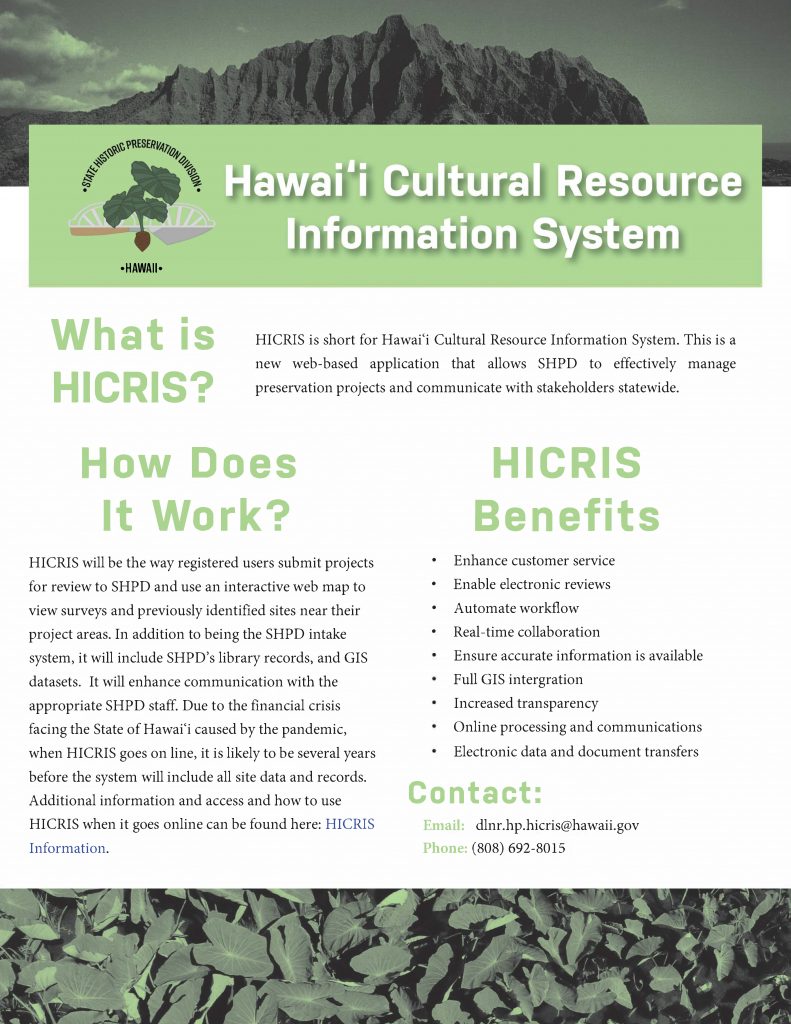
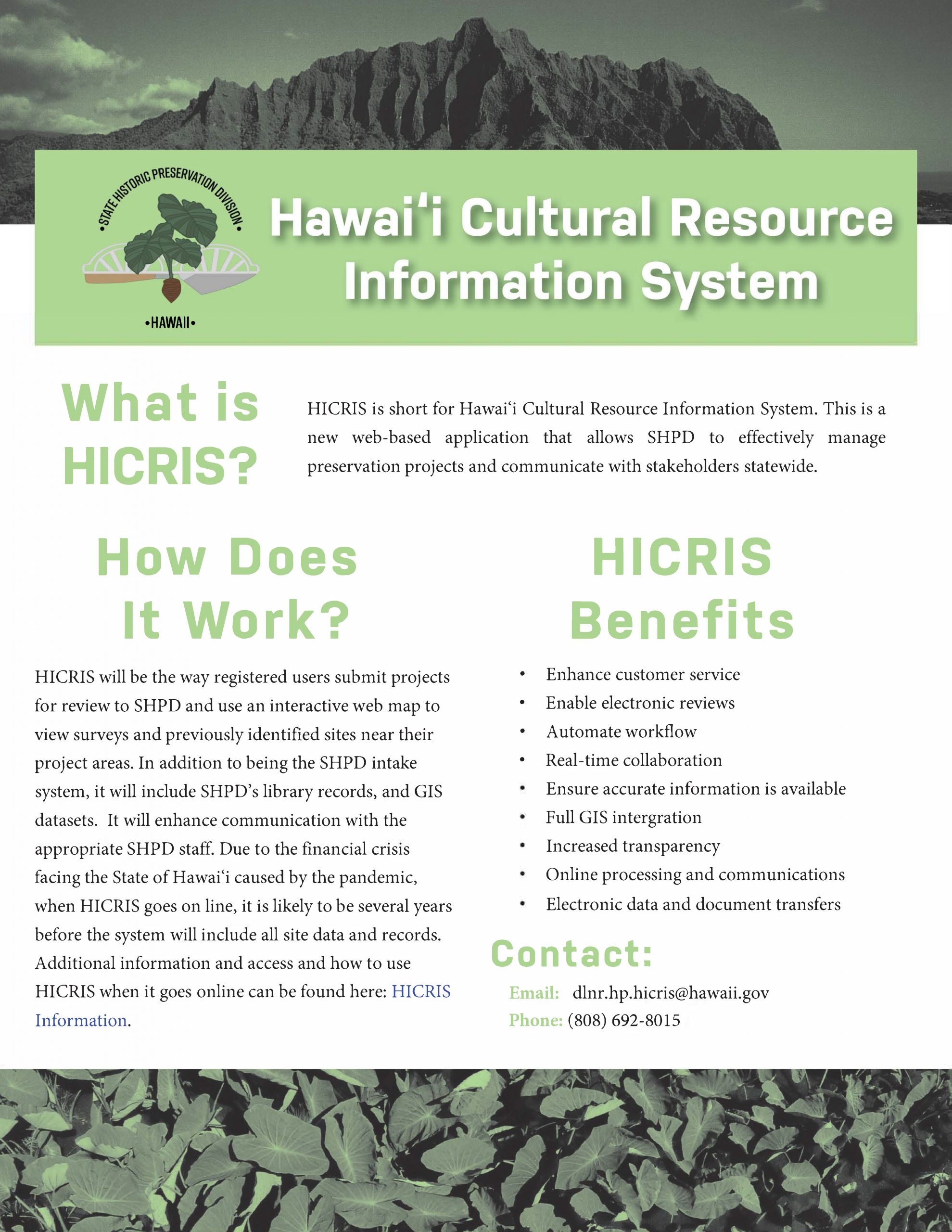
Hawaii Cultural Resource Information System (HICRIS) Launch Date: December 17, 2020
- COVID-19 NOTICE
IMPORTANT COVID-19 NOTICE:
SHPD offices are currently open to the public but we ask that appointments be made to ensure staff is available to assist you. To make an appointment, please call 808-692-8015.
To submit information to SHPD it must be done electronically via the Hawaii Cultural Resource Information System (HICRIS).
To report the inadvertent discovery of human remains call:
On Kaua`i please call: (808) 462-3225
On Hawai`i Island please call: (808) 694-9988 or (808) 494-2282
On Maui please call: (808) 652-1510 or (808) 694-9435
On O`ahu please call: (808) 856-1576 or (808) 798-0526
I Mua Mondays: Beginning on Monday, April 8, 2019, SHPD will institute “I MUA MONDAYS.” Every Monday, until terminated or suspended in writing by the Administrator, SHPD will be closed to the public; we will not accept meetings, phone calls, emails, or “walk-ins” on Mondays. The SHPD Library will be closed to the public. This policy has been approved at the highest levels in the Administration.
I Mua Mondays will allow SHPD staff to work on critical technical and administrative tasks without interruption. This will eliminate distractions and help us expedite processing of project reviews, and the rest of our essential work. All SHPD staff are required to comply with the policies in this memorandum without exception.
Library Notice: SHPD library material does not circulate and all research must take place in our offices. Photocopies may be made at $0.50 per printed page per HRS Section 92-21 governing duplication and reproduction fees. The Kapolei office also provides a scanner for your use and you may save scans to a CD/DVD (no thumb drives). All researchers (public, agencies, etc.) must request an appointment. This allows SHPD to determine if the library is available at the requested time or has been previously reserved for a meeting or conference call. Make an appointment to visit the Kapolei library by emailing: [email protected]. SHPD staff are not available to conduct research on behalf of the public, agencies, etc., but SHPD staff are available to: schedule appointments and assist with access/training on the use of the scanner.